Showing posts with label Word Work. Show all posts

Friday, 13 July 2018

Teaching Phonics with Phonemic Awareness Integration: The Codepack

If you're like me (I didn't get my start in Primary; I began my year as a high school teacher and all my elementary LTOs were between grades 6-8), you've felt panicked and ask yourself, "How am I going to teach these children how to read?" It's a terrifying feeling - especially when you may have many who don't even have their letter sounds yet!

Luckily, I was able to be a part of LDSB's MISA project a few years ago. It was led by our literacy consultant and we combined her passion for early literacy with some amazing things that are happening with our local Reading Clinic. We wanted to test with going back to the basics (phonics), individualized learning, and building a resource base to see if it made an impact on students' phonics knowledge, phonemic awareness, reading scores, and writing.

Our presentation board at the MISA Eastern Ontario sharing summit in 2017.


We carefully tracked our data using assessments like phonics screeners, phonemic awareness (focusing on blending and segmenting), reading scores, writing samples, and spelling (I found Words Their Way as an excellent tool because it mirrors our phonics continuum almost perfectly!).

The phonics screener is an individual meeting with each student to find out which sounds of letters they know. The student is shown a letter and they have to tell its sound. For Ontario Kindergarten, we usually keep it to consonants and short vowels. However, several students know digraphs, long vowels, and a few advanced phonics like dipthongs by the end of the year. Knowing letter sounds is a specific goal in the play-based Ontario Kindergarten program. Because you're tracking it, it's very easy to show (and report on) growth in this area as key learning, if you want.

Every student has a codepack. It consists of the sounds (letters) they know. Note that each level of phonics has a different colour. Here, consonants are green, short vowels are pink, split long vowels are white, digraphs are yellow, and dipthongs/vowel digraphs are blue. I chose to use pencil cases found at a local thrift store to store them in, labelled with each student's name.

Now, here's the fun part - the part where you begin working with students. It can be done individually or as a group, as a warm-up or word work center, with a volunteer or Student Support Teacher, etc.. This is where the learning and growth starts. I'll write it as a list to help you with the steps. This is how I do it in SK/1 and Kindergarten - but there are many ways I've seen and heard this used (in grades all the way up to high school levels!).


  1. Students review the letters in their codepack. By themselves, with a peer, or an educator, students can flip through their known letters (information you get from their first phonics screener). Yes. We are only including their known letters. I keep their known letters loose  and their unknown cards in an alligator clip in the case.
    * As you continue and students master working with their known letters, begin to add 1-3 cards  to their codepack's loose letters (how many and how often is up to you - you know the student best!). Incorporate those new pieces of phonetic code into the following activities to help ingrain it in memory and get your student comfortable working with it. Some students master code and add new cards very quickly - others need a lot more repetition and to go more slowly.
Why do we only work with letters we know (and slowly introduce new letters to learn)? Here's a piece I'd included in my shared writing blog post.

  1. Choose some letters and set them out. I try to put out max 10 - fewer cards for struggling students. Make sure you include sounds you can combine to create words. You may choose to quickly review these sounds with the student, "Point to the card that says /p/. Now point to the one that says /th/."
  2. Now it's time to practice sound segmentation! Ask the student to use the cards to spell words (this is why you have to carefully choose the letters you have out). For example, "Can you use the cards to spell DOG? Let's sound it out together - /d/, /o/, /g/. What was the first sound? Which card here makes that sound? Okay, pull the /d/ down. What's the next sound you hear in the word DOG?" You can see how the goal is to have your student(s) begin to segment independently - and apply this during their independent writing.
  3. Here, a student has sound segmented to spell the word 'big' using their phonics cards.
  4. Let's integrate sound blending - a skill necessary for reading! The educator will use the cards to spell a word for the student. The student will need to put the sounds together to read the word. The magic is that the student already knows all of the sounds - they just need to put it together! This is a huge confidence-boost!
    I was having troubles with students not being able to blend. I'm fairly certain it's because they were pointing to each letter and saying the sound individually - as if they were sound segmenting: /s/, /a/, /t/. Our literacy consultant helped me problem-solve this by modeling and having my students slide their finger along the word and hold the sounds, so it sounds more like "sssssssaaaaaaaat." I found a lot more success that way.
Now, I'll explain what I do beyond our codepack activities. Think of it as an extension. The codepack activity itself can take as little as 5 minutes, if needed, once you become efficient and get to know your students. I'll use photos to help explain and give an idea.

 Phonics Pack - TPT
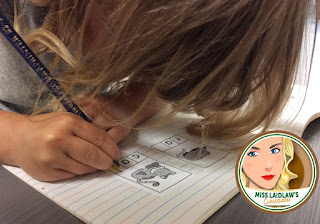
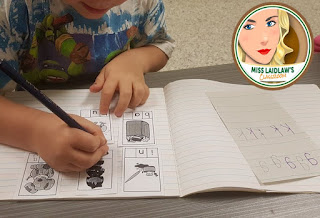
In a notebook (I use the half-size notebooks.), students glue in their phonics cards - which consists of this TPT product of mine photocopied 8-to-a-page. I select cards for sounds they know - ideally, sounds we just practiced using our codepack. Other things we focus on and I teach during this time, if needed: pencil grip & letter formation (do some of that Occupational Therapy work!).
In my SK/1 class, I've done this as an independent warm-up, a word work center, guided work with me, and left it as an optional activity - always accessible to students (I glued a library pocket into the front and continually put new cards at the child's level in). Students would use a date stamp so I could observe progress.

 Phonics Cards - TPT
Looking to become more organized, I decided to store my phonics cards using hockey card pages from the dollar store! I found the cards slipped out easily, so I added some velcro to keep the slots closed. They're organized by level: consonants at the front, then short vowels, followed by digraphs, long vowels, r-controlled vowels, and so on.

 Phonics Cards - TPT
Sometimes, I added printing paper for students to practice their letter formation. It's important that students see you while you're writing the letter. Handwriting Without Tears is a popular resource for those of us who are unfamiliar with the conventional, "proper" ways of writing letters. I often came up with little stories to help students remember how the letter is written - for example, "A lowercase G is a c with a monkey tail that hangs below the line." We practiced tall, short, and hanging letters. I only used this strategy for difficult letters - and it was personalized (we never all practiced witing lowercase Gs together). I found this paper at the Dollar Tree store.

Once students start becoming comfortable with the skill of sound blending, they can begin reading phonetic readers. However, please keep in mine that not all books labelled as phonetic readers are truly so - they often contain words students will have no idea how to decode independently. They only contain some words (often bolded) focusing on a phonics skill. I recommend Scholastic's BOB BOOKS (pictured). Your school may also have the Primary Phonics books available. You'll notice these texts only contain words which students can decode independently! This is amazing because students see themselves as readers; they don't need adult help and get a huge confidence-boost when they realize, "Hey, I know all the sounds in this book already. I just need to blend them together to get the word!" These books will include common sight words - even at beginning levels.
Utilize phonetic readers to being writing sentences! I photocopied pictures from our BOB BOOKS and trimmed off the words (store with the sentence paperclipped to the bundle so you know the corresponding sentence!). Choose one from the child's level - perhaps even after the student finishes reading that book! Dictate the sentence and the child will write it. You'll notice this practices the phonemic awareness skill of counting words - and you can use it as a platform for teaching basic writing conventions - such as leaving spaces between words and ending punctuation.

Get a group together. This can work with a mixed-level group of students! (Why not have more advanced students modeling and explaining how to sound segment?) Use one codepack and give each student a few letters (in the picture, there are 3 students working together). Say a word and have them segment and work together to spell it. Who has the sound card needed? The conversations you'll hear are amazing - plus, this is practicing several Learning Skills as well!

 Phonics Cards - TPT
Use the assessment information you've acquired to create literacy provocations. These cards are simply full-sized, colour versions of the smaller cards I photocopied for students' notebooks! Click the image to bring you to the product on TPT!


Collect tools to help your students learn letters and their sounds. I have a huge collection of these magenetic toys - and I've found all of them at thrift stores (except for one, which was donated by a friend after her children outgrew it). There are also toys that have the entire alphabet displayed and can say the letter name and/or sound when its button is pressed - a great addition to a writing area (no more "Miss Laidlaw, what letter makes the /n/ sound?").
I recenty saw this on Twitter - what a genius idea! Let's add coding and technology to our phonics. I'm already buzzing with ideas on how to integrate our codepacks with my Code-and-Go Mouse, Code-a-Pillar, and unplugged coding opportunities.
 Shared Wrting for Early Primary Students
Have you read my post about Shared Writing for Early Primary Students? You can read about it HERE! You can use your assessment data from the above activities to progress your students' writing. With shared writing, you can model so many other aspects of writing - see the full post for all the juicy details!


Create a display to show learning! We had a lot of student interest in Angry Birds, so they created Angry Verbs! I just printed some colouring pages and students wrote words using -ing (we were learning the /ng/ sound). Be creative!


TYMTR is a free website to practice phonics, sight words, and phonemic awareness. The app (available on Android and Apple) is sometimes free. As an educator, you can create a class account and track students' progress along its 3 levels. I start all students on the first level - it's a fun game, so there's never been any complaints from students working with more advanced phonics!

Expose students to letters and their sounds in fun ways. We have staggered dismissal in my class (students going to bus, programs, and parent pick-up). I made an end-of-day YouTube playlist which includes cross-curricular songs - including the amazing Letters Get Down songs! It's great for some DPA or body breaks, too, because he includes actions for every letter! Click the image to see my phonics playlist on YouTube!


Here's a FREE DOWNLOAD of the modified assessment tool and flashcards I've created. Get the document at https://www.teacherspayteachers.com/Product/Phonics-Assessment-and-Codepack-for-integration-with-Phonemic-Awareness-3916744.


I'm hoping you found this post helpful on your teaching journey. Have some ideas? Questions? Feel free to share by posting in the comments!

Tuesday, 9 May 2017

Shared Writing ... follow-up

I'm really starting to see a big difference in my students since spending more time on their phonics and writing rather than all our time on reading. Not only are most writing independently now - but their reading is also bumping up!

Parents are also excited and on board. Recently, a parent of a Senior Kindergarten student in my class sent me this article: https://www.parent.co/sight-words-are-so-2016-new-study-finds-the-real-key-to-early-literacy/. It's worth a read and gives plenty of research about why invented writing using existing knowledge is a very important skill.

In my phonetic knowledge teaching quest, I also learned about Teach Your Monster to Read. It's a free program on the computer (also available as an app - which is sometimes available for free as a promotion) which explicitly teaches letters and their sounds. I really like that it goes back and reviews prior learning and also sprinkles in some sight words and application of reading and spelling. Students love the different games - which are all laid out in developmental order (consonants first, short vowels - all the way up to r-controlled vowels and dipthongs).

As for shared writing, some colleagues and I have started using pieces of art (visual art, dance, music, etc.) for students to view, discuss, and write about. It's cross-curricular! Grab the freebie observation checklist at https://www.teacherspayteachers.com/Product/Student-Observation-Checklist-for-Shared-Writing-Ontario-Grade-1-Visual-Art-3151638.

To read my in-depth blog post about phonics and shared writing, go to: http://misslaidlaw.blogspot.ca/2017/02/shared-writing-for-early-writers.html.

Sunday, 26 February 2017

Shared Writing for Early Writers

I teach a group of Senior Kindergarten and Grade 1 students. When it comes to writing, my students mainly struggle with:
- sound segmentation ("sounding it out")
- encoding (assigning letters to the sounds they hear)
- writing full ideas (complete sentences)
- writing more than one sentence on a topic.

They were writing one sentence - often incomplete, and usually repetitive and simple ("I love Mom. I love Dad.").

So, enter shared writing! Usually used with upper grades with focuses on ideas, grammar, and higher-level skills, my SK/1 focus is on our needs (which were common "next steps" on our 1st Term report cards).

We do it every morning before our Daily 5 choice time (we have Gym in-between on some days - but we have to work around those schedules, right?). The reasoning behind this is so they have constant reminders to use the segmentation skills and phonics knowledge when writing independently. The oral language piece is very important too - and ties into an inquiry our Student Support Teacher is doing concerning the importance and development of oral language and conversation skills. My students crave it and ask for it; it's become part of our routine.

ReadWriteThink.org
We use the "Let's Talk About It!" picture boards. They've been collecting dust in our teacher workroom. You could easily use pieces of art, newspaper pictures, or pictures from Google Images. Students choose a picture at the beginning of our day to be used during our shared writing session.


We start by looking at the picture. Students talk with a partner or small groups. This is excellent for building oral communication skills, gathering and building ideas, and Learning Skills (especially "Collaboration"). 

As you can see, talking with their groups can get quite animated!
After, we share our ideas as a class. I do this organically - no hands. They instinctually take turns - politely interrupt and add and ask questions. If you prefer, you can collect and share ideas with traditional raising hands and taking turns as appointed by the teacher. This is an excellent time to also accept, analyse, and choose between conflicting ideas. For example, some students thought the tiger was growling - until one student said it was yawning. They looked at its body language (and it was laying under a tree) and decided it was yawning.

Students decided the tiger was yawning - not growling.
I take the pen (well, smelly marker!). I do the writing during shared writing for a variety of reasons - including time management. I need to maintain our learning focuses: sound segmentation, encoding, and writing more than one sentence on a topic.

"Where do we begin? What's a good idea or sentence to introduce what's happening here?" I remind students to stay away from vague pronouns such as it. "What if our reader couldn't see the picture? Would they know what it is?"

Then, word by word, we segment. Students tell me which letter to write down. Some students might know it's on our word wall and run to get the word (this happened when we needed "bear") and some might already know the spelling of a sight word ("out" and "to" are common ones in our writing). It's important to note that PROPER SPELLING DOESN'T MATTER! These are beginning writers - and many SK/1 students are at the Short Vowel Stage in Words Their Way, so it's unfair to expect them to know long vowel patterns, r-controlled vowels, and dipthongs.

Why are words spelled wrong? Because students are applying the code they know. Therefore, this is developmentally-appropriate. It doesn't discourage them by correcting and "teaching" all the nuances of the English language and its spellings.


I constantly reread what I've written to see where I am in the sentence and to make sure everything is on the same topic. Students tell me which ideas to write next.

Here's our first Shared Writing with this focus. It's quite simple - but includes a few inferences. The sentences are very simple.

Here is our most recent shared writing. Within a month, students have added details (names), made more inferences, and explored a variety of punctuation (quotations) and grammar rules.
I've definitely noticed a big impact on my students' independent writing!

Grade 1 writing - with some help segmenting. The student encoded independently.
Students can write about whatever they want. To save them from wasting time thinking of an idea, we have an "idea box" - a brightly-coloured box on our shelf next to their journals. In it are cut-outs from a variety of magazines (travel, outdoors, home, wedding, teaching, construction union, parenting, fashion, etc.). I am conscious of including diversities - such as special needs found in sections of educational supplies catalogues, people of colour, religious and cultural clothing and regalia, et cetera.

It's no longer junk mail! Cut pictures from magazines to add to your "idea box" to inspire student writing!

Read about how I keep track of my assessments (like the one provided above) in my binder at http://misslaidlaw.blogspot.ca/2017/02/assessment-and-tracking.html.

Thursday, 27 August 2015

My Literacy Block

I've been asked a lot lately about what my literacy block looks like. I've toyed around with it a lot to find out what works for me and is easily-adaptable for occasional teachers who come to my classroom. I found something that I had high yields with, incorporates several elements of my style and philosophy, and accommodates a variety of learners (differentiated, behavioural needs, etc.).

I like having my Language block in the middle of my day. In the morning, students are often dropped off late. This is a common complaint from a lot of Kindergarten teachers I know - "Little Suzie is always 30 minutes late to class! She always missed Language!" Why don't you change it to the middle block, then? Or how about how school assemblies are always in the first block? This can wreck havoc on your plans!

My middle blocks (at the 3 schools I've taught in) are usually 100 minutes long - provided there's no planning at that time, leaving tons of room for a variety of activities and integration of other subjects. Students are awake, fed, and (hopefully) tired from recess.

Here's what my typical block looks like in the Grades 1/2 classes I've taught. I'm moving to SK/1 this year, so will be tweaking it a bit.

1. Welcome Back From Recess

Welcome back from recess. One year, I had a very high-energy class with a ton of behavioural needs and often lots of recess issues needing to be dealt with. They had nutrition break before recess. Students came in after recess and sat or lay down on the carpet and watched "Super Why" on NetFlix (I had no technology in my classroom, so I bought my own projector and iPad to facilitate this).

Last year (new school), I had a small country class of 16 students. They came in from recess, grabbed their lunchbags, and ate in the cafeteria. When I picked them up from the cafeteria - while still in line, I told them what they needed to do to prepare for class - usually: put your lunchbag away, get your literacy bin and put it on your desk, and wait quietly on the carpet. This was routine and they could recite it by heart within a week - very helpful for occasional teachers!

2. Ready to Begin

How do I start my Language block? Students are at the carpet and I am at the easel. Every week, we have a new poem to close read. Close reading is a skill typically taught in intermediate grades and in high school - reading the text several times with difference focuses: vocabulary, connections, inferences (much like how we, in primary grades, have a read-aloud that's the same every day but each day focuses on a different skill).

On the easel, I have a zoomed photocopy of the poem. I tell students I will read the poem once and their purpose for listening is to listen for pleasure. I read the poem out loud in a natural voice. Then, I read it again and tell the students their purpose for listening. However, unlike in older grades, our focus is on decoding skills and expanding vocabulary (if you use CAFE reading strategies, the A and E skills!).

For example, on Monday, I will say "Now, your purpose for listening is to find words you don't know. When you hear a word you don't know, please [clap your hands, touch your nose, stick your tongue out...]." On Tuesday, they may look for the /k/ sound - and so on. As the year goes on, we move on to blends, digraphs, long vowel patterns, and maybe prefixes and suffixes like -ed and -ing. I base what decoding skills to look for by my information from guided reading, Words Their Way assessments, Sound Skills assessments (syllables, sound segmentation, rhymes, etc.), reading levels, and running records.

A student fills-in-the-blank with a sight word for this particular poem.
This is a good chance to explicitly teach penmanship and proper letter formation!


After the second reading, I invite one student at a time to come up and mark up the text. For example, on Monday, we circle unknown words and draw pictures to help show us what it means. I tell them what it means (strategy: ask someone) and later in the year, model how to use dictionaries or the Internet to find its meaning. The phonemes throughout the week are highlighted in different colours - for example, Tuesday's /k/ sounds in yellow, Wednesday's /ch/ in green, Thursday's "ing" in purple, and Friday's /ee/ in orange. I've also taught punctuation with our weekly poems (capitals, ending punctuation, quotation marks, etc.).


After that, students go to their own desks. In their literacy bin is a poetry duotang. Every Monday, they receive their weekly poem. Time saver: spend a few days to explicitly teach them how to put their new pages in the duotang. This will save you aggravation and also save your thumbs - as well as teach them independence and develop fine motor skills. On their own copy, students do the same as what we marked up on our master copy of the poem.

Kill two birds with one stone by integrating - Science, Social Studies ... even Math!
Also, you can see we found "words within words" (including compound words) and circled them.
Quick note: on Mondays, when we find unknown words, I also make them add the words into our "Word Collector" - which I photocopy on coloured paper and place in the front of their duotang. One made specifically for primary grades is available for free at my TPT store at https://www.teacherspayteachers.com/Product/Expanding-Vocabulary-Word-Collector-FREEBIE-1332540. As always, feedback is greatly appreciated.

Early finishers can read the poem to themselves then to a friend (or two - or three). This helps them build reading fluency and holds them accountable to learn how to read. By Friday, even the readers who struggle most are able to read the poem - even if they've just memorized it. I also give them the option to go back and read their favourite poems from earlier weeks.

An example from June's weekly poetry close read in a Grades 1/2 classroom.


Where do I find these poems? There are a few TPT sellers who have them for sale, but I prefer using phonics poetry resources - usually by Scholastic. I borrow the books from the Queen's University Teachers' Resource Centre (my school board has a partnership with the local Faculty of Education and we're allowed to borrow!). Experienced teachers often have a few of these books lying around, too. On Remembrance Day week, I teach them the first few verses of Flanders Fields. We learn Oh Canada's lyrics - and during celebrations/holidays, we learn poetry and lyrics to do with that celebration, holiday, or season.

3. Daily 5

Students clean up (put their poetry book back in their literacy bin and put any markers/crayons away) and meet me on the carpet. I assign Daily 5 stations. I like the idea of choice - but it never worked for me in a Grade 1/2 classroom.

Details of how I assign centres can be found in this blog post: http://misslaidlaw.blogspot.ca/2014/09/centres-organization.html. Students stay on the same station for the whole time - so really, it's not "Daily 5." However, students practice each skill at some point during this block. I do not include "Read to Somebody" as I've never had very much success with it - and have built time into the poetry lesson to accommodate it.

Our time at the centre is usually 15-20 minutes long. Obviously, we practice building stamina and begin at 1 or 2 minutes. One students are able to do it independently, I am able to have guided reading meetings and conferencing with students. I won't get into extreme detail about guided meetings - but I use a variety of resources - including Reading A-Z, commercial guided reading resources, Sound Skills games and lessons, Word Their Way games, and other meaningful, highly interactive gems I've come across. I have a binder with a section for each student where I write anecdotal notes about their progress, including: reading level, strengths and needs (The CAFE book by The Sisters is impeccable for this - especially for those new to teaching Primary!, and other useful information. This is great when it's time to talk to occupational therapists, speech pathologists, educational psychologists, parent-teacher nights, collaborative inquiries and staff meetings, student support teachers and writing report cards.

My Word Wall is a hybrid: on rings and stapled onto the corkboard. On rings, I have Dolch words (http://misslaidlaw.blogspot.ca/2014/08/its-final-countdown.html). I have them colour-coded by level. They're available for purchase at a very reasonable price at my TPT store. They've been laminated and hole-punched and put on a shower ring (usually a dozen in a package at Dollarama). This helps students with Work on Writing and Word Work stations.

Words that change with the unit (Math, Science, Social Studies) are stapled for quick-access (and removal after the unit) in the appropriate spot on the word wall. Students usually end up writing these words in their personal dictionaries.


I've chosen to use Words Their Way in my classroom. I assess students at the beginning of the year (end of September - maybe October), after Winter Break, perhaps around March Break, and at the end of the year (to show growth). This information is not only useful in-class (and to help know what to do with the poetry decoding and guided reading), but to share for IPRCs and on IEPs.

This is the base of my Word Work program. I've chosen to give spelling tests every Friday - typically, I have 2-4 groups of students based on levels they achieve  (consonants, short vowels, blends/digraphs, and/or long vowels, usually - through the span of the year). The resource is great - word lists (helpful for choosing your weekly spelling words - I focus on 3 and move to 5 in the last month or two ... kids love it). I don't even keep track of how they do - as spelling is a minor component of our Language (Writing) curriculum in Ontario. However, I don't assign homework - but gives parents/guardians who love the idea of homework something to do other than "just read."


4. "The Lesson"

Look how much learning has already been done! This part of my day varies - depending on our learning goal.

This is when we have our read-aloud. Teacher tip: read the same book every day of the week! For example, on Monday - don't even read it! Make predictions and make a schema (prior knowledge) chart. On Tuesday, read the book (or even stop in the middle and ask students to say/write their prediction about the end). On Wednesday, practice retelling then read the rest of the story then do an after-reading follow-up. On Thursday, play a YouTube video of the story's reading - or find it on EPIC! For Educators (a free app on the iPad), TumbleBooks, or another media site. On Friday, have students do an extension activity - act it out, make connections, an Art activity, et cetera.

This should be your entire block. As you can see, students have the opportunities to practice a variety of skills, move around, and aren't on one task for too long (less risk of tuning out, behavioural issues, giving up, and just plain not having fun while learning). Early finishers can complete unfinished work or have their choice of a Daily 5 station.


What's in their literacy bins?
- personal dictionary (I like this freebie: https://www.teacherspayteachers.com/Product/Personal-Dictionary-Foldable-467202)
- poetry book
- any other folders and duotangs you use (novel studies, book studies, Sound Skills, word/sound sort books)
- sometimes, I put at-level books from Reading A-Z or guided reading resources (especially for lower-level readers)